
Why UK Businesses Are Rethinking AI-Powered Customer Support in 2026
I have spoken to dozens of UK business owners over the past two years and almost all of them ask me the same question. Should I use an AI chatbot or stick with live chat?
It is a fair question and honestly, the answer is not as simple as most blogs make it sound.
Customer support in the UK has changed dramatically. Rising customer expectations, tighter budgets and the rise of AI-powered customer support have forced UK businesses of all sizes to rethink how they handle customer conversations. This is not a small tweak. It is part of a much larger UK business digital transformation that is reshaping how companies operate. What worked in 2022 simply does not cut it anymore.
f you are a UK business owner or a marketing manager trying to make this decision, you are in the right place. I am going to walk you through everything you need to know in plain English.
Table of Contents
What Is an AI Chatbot? A Plain-English Guide for UK Business Owners
Let me be honest with you. When I first started exploring AI chatbots for business use, I found most explanations either too technical or too vague. So I want to give you a straightforward answer that actually makes sense.
An AI chatbot sometimes called an intelligent virtual assistant — is a software tool that talks to your customers automatically. It sits on your website, your WhatsApp, or your social media page and responds to customer messages in real time without a human agent involved. Modern AI chatbots are powered by conversational AI and natural language processing, which means they do not just match keywords. They actually understand the intent behind what your customer is typing.
But here is the part most people miss. Not all chatbots are the same. A basic rule-based bot follows a fixed script if a customer types something outside that script, it fails. A modern AI-powered chatbot uses natural language processing to interpret what your customer actually means, even when they phrase things in unexpected ways. That difference is enormous when it comes to automated customer service for UK businesses.
For UK business owners evaluating an AI bot for their website, understanding this distinction is the difference between a tool that frustrates your customers and one that genuinely improves their experience. Conversational AI for business in the UK has matured significantly and choosing the right type of chatbot is the first decision you need to get right.
What Is Live Chat and Why Do UK Customers Still Trust It?
There is something I have noticed consistently when working with UK businesses. Even when an AI chatbot is available on their website, a large portion of their customers still click the live chat button and wait for a real person.
That tells me something important. Trust matters deeply to UK customers, and live chat delivers that trust through real-time customer communication in a way that AI simply cannot replicate yet.
Live chat is exactly what it sounds like. A real human agent sits behind a screen and responds to customer messages in real time. No automation. No scripts. Just a genuine person helping another person solve a problem.
For many UK customers especially those dealing with anything financial, medical or emotionally sensitive that human connection is not optional. It is essential.
AI Chatbot vs Live Chat: Real Cost Comparison for UK Businesses in 2026 (£)
One of the first questions I get from UK business owners is a simple one. How much does this actually cost me?
It is the right question to ask. And I find it frustrating that almost every article on this topic quotes prices in dollars. That does not help a business owner in Birmingham or Bristol trying to plan a real budget.
So let me break this down properly in pounds sterling based on what UK businesses are actually paying for customer support automation right now in 2026. I will cover both the AI chatbot cost per interaction and the live chat agent cost so you can make a direct comparison.
Head-to-Head Comparison: AI Chatbot vs Live Chat for UK Businesses in 2026
I know that reading through long articles is not always practical when you are a busy UK business owner. Sometimes you just want to see the facts laid out clearly side by side.
So I have put together this head-to-head comparison of human agent vs AI bot for UK businesses based on real data, my own experience and the latest 2026 market information. This is the table I wish existed when I first started researching this topic. It covers everything from real-time customer communication speed to cost per interaction.
What Is the Difference Between an AI Chatbot and Live Chat?
The core difference is simple. An AI chatbot is software that handles customer conversations automatically using artificial intelligence. Live chat connects customers to a real human agent who responds personally in real time. AI chatbots are faster, cheaper and available around the clock. Live chat agents are more empathetic, better at handling complexity and trusted more by UK customers for sensitive matters. Most UK businesses in 2026 benefit from using both.
| Feature | AI Chatbot | Live Chat |
|---|---|---|
| Response Time | Under 10 seconds | 35 seconds to 3 minutes on average |
| Availability | 24 hours 7 days a week | Typically business hours only |
| Cost Per Interaction | £0.40 to £0.80 | £4 to £9 |
| Handles Complex Queries | Limited | Very strong |
| Empathy and Emotional Intelligence | None | High |
| GDPR Compliance Readiness | Requires careful platform selection not all providers store data in UK-compliant locations | Easier to control |
| Scalability | Unlimited simultaneous chats | 3 to 6 chats per agent |
| Best For | Routine queries, lead capture, 24/7 availability and high-volume support | Complex issues, high-value sales, complaints and emotionally sensitive conversations |
| Setup Time | A few days to weeks | Immediate with right staff |
| Customer Satisfaction Score | Good for simple queries | Higher for complex issues |
When you look at this chatbot vs human support comparison for UK businesses, the pattern is clear. AI chatbots win on speed, cost and availability. Live chat wins on empathy, complexity and customer satisfaction. The data on customer satisfaction with live chat in the UK consistently shows higher scores when customers are dealing with problems that require judgement or emotional understanding. Neither option is universally better. The right choice depends on what your customers actually need from you.
Which UK Industries Need AI Chatbots vs Live Chat? Industry-by-Industry Breakdown
One thing I have learned from working across different sectors is that there is no single right answer for every UK business. The chatbot customer experience varies dramatically by industry. What works brilliantly for an e-commerce store could be completely wrong for a law firm. The best choice depends heavily on your industry, your customers and the type of conversations you handle daily.
Let me break this down industry by industry so you can find your situation immediately. I will start with UK e-commerce customer support since that is where the majority of my readers operate.
Which UK Industries Need AI Chatbots vs Live Chat? Industry-by-Industry Breakdown
Every UK industry has different customers, different query types and different compliance pressures. I have worked across enough sectors to know that a one-size-fits-all recommendation simply does not exist here.
Let me give you a direct answer for your specific industry.
E-Commerce and Online Retail : Chatbot First
UK online retailers deal with massive volumes of repetitive queries every single day. Order tracking, returns, delivery updates and product questions are all perfect for AI automation. Chatbot lead generation for UK e-commerce businesses is also genuinely powerful as bots capture browsing visitors before they leave. Start with a chatbot and add live escalation for complaints only.
Financial Services : Live Chat First
FCA regulations make this sector one where I always recommend caution with AI automation. Live chat should be your primary channel for anything involving accounts, transactions or financial guidance. Use chatbots only for basic informational queries like product overviews or branch hours. Never automate regulated advice conversations.
Healthcare and NHS-Adjacent Services : Live Chat Essential
Patient trust is everything in this sector. Whether you run a private clinic, a healthcare app or an NHS-adjacent service, human support must be your foundation. AI chatbots work well for appointment booking and general service information but any clinical, personal or urgent query needs a real person responding immediately.
Legal Services : Hybrid Recommended
Legal queries often start simple and quickly become complex. I recommend using an AI chatbot to handle initial intake, qualify the enquiry and capture contact details. Then route the conversation to a qualified human as quickly as possible. No AI should be giving legal guidance unsupervised in any UK practice.
SaaS and Technology : Chatbot First
This is the sector where AI chatbots deliver the clearest return on investment. SaaS customers ask predictable questions about features, pricing, integrations and account management. A well trained chatbot handles the majority of these instantly. Keep live chat available for technical escalations and enterprise sales conversations.
Hospitality and Travel : Chatbot First with Live Escalation
UK hospitality businesses benefit enormously from 24 hour AI chatbot availability for booking queries, availability checks and cancellation policies. However when a guest has a complaint or a genuinely urgent travel issue they need a human. Build clear escalation triggers around these moments.
Professional Services : Live Chat First
Consultancies, accountants and agencies sell trust and expertise above everything else. I always recommend live chat as the primary channel here because clients want to feel heard and understood from the very first conversation. Use AI only for appointment scheduling and basic enquiry capture.
AI Chatbot GDPR Compliance UK: What Every Business Must Know in 2026
This is the section I wish more UK business owners would read before deploying any chat tool on their website.
I have seen businesses invest thousands of pounds into AI chatbot setups only to realise months later that their platform was not compliant with UK data protection law. The consequences of getting this wrong are serious. The ICO can issue fines of up to £17.5 million or 4% of annual turnover, whichever is higher. Beyond fines, customer complaints and reputational damage are very real risks that can take years to recover from.
Let me walk you through what you actually need to know about conversational AI compliance for business in the UK and how natural language processing chatbots handle personal data.
Does My Chatbot Need to Comply with UK GDPR?
Yes, absolutely and without exception.
If your AI chatbot collects any personal information from UK users including names, email addresses, phone numbers or even IP addresses it falls under UK GDPR. This applies whether you built the chatbot yourself or use a third party platform. The ICO is very clear on this and ignorance of the rules is not a defence.
I have seen UK businesses assume that because their chatbot is just “a little widget on the website” it somehow sits outside data protection law. It does not. The moment it touches personal data it is in scope.
Data Storage and Processing Requirements
Where your chatbot stores data is one of the most important questions you need to answer before going live.
Under UK GDPR your chatbot platform must store customer data either within the UK or within a country that meets UK adequacy standards. Most EEA countries currently meet these standards post Brexit but this is worth verifying with your provider directly.
You also need a lawful basis for every piece of data your chatbot collects. For most UK businesses consent is the most straightforward basis. This means your chatbot must clearly inform users what data it is collecting before collecting it and give them a genuine choice to opt out.
Do not bury this information in a privacy policy link. Make it visible and clear within the chat interface itself.
Customer Rights Under UK GDPR
UK customers have specific rights over data collected by your chatbot and your systems must be able to honour them.
Right to access. Any customer can request a copy of the data your chatbot has collected about them. You must be able to provide this within 30 days.
Right to erasure. Customers can ask you to delete their data. Your chatbot platform must support this and you need a clear internal process to action it quickly.
Right to portability. Customers can request their data in a format that allows them to take it elsewhere. Make sure your platform can export conversation data in a readable format.
How to Check If Your Chatbot Platform Is GDPR Compliant
Before committing to any platform I run through this practical checklist.
- Does the platform store data in the UK or EEA?
- Is there a signed Data Processing Agreement available?
- Can you set custom data retention periods?
- Does the platform support user deletion requests?
- Is there clear documentation of how data is encrypted?
- Has the provider published an up to date privacy policy covering UK GDPR?
UK Online Safety Act & AI Chatbot Rules: What Changed in 2026,
If you are deploying an AI chatbot on your UK website in 2026 this section could be the most important thing you read today.
The regulatory landscape around AI tools in the UK shifted significantly in early 2026. The Online Safety Act originally focused on social media platforms, but its reach has expanded. AI-powered chat tools are now firmly within its scope. Most UK business owners I speak to are completely unaware of this, and that worries me.
What the UK Online Safety Act Means for Your Chatbot
Most UK business owners I speak to have heard of the Online Safety Act but assume it only applies to social media platforms. That assumption is increasingly dangerous in 2026.
The Online Safety Act has broadened its scope significantly. If your AI chatbot interacts with UK users and could potentially expose them to harmful content or fail to protect vulnerable individuals your business now falls within its regulatory reach.
Here is what the legislation specifically requires from businesses deploying AI chat tools.
Risk assessments are mandatory. You must formally assess what harmful content your chatbot could generate or facilitate given your audience and the nature of your service. This is not optional and it needs to be documented.
Harmful content prevention must be built in. Your chatbot must have active filters and safeguards that prevent it from producing content that could cause harm. This includes misinformation, dangerous advice and anything that could negatively affect a vulnerable user.
Vulnerable user protections must be considered. If there is any reasonable chance that children or vulnerable adults use your service your chatbot must have additional safeguards in place. This includes detecting distress signals and escalating those conversations to a human immediately.
Who Enforces Compliance and What Happens If You Get It Wrong
Ofcom is the regulatory body responsible for enforcing the Online Safety Act in the UK and it has real teeth.
Businesses found to be non-compliant face fines of up to £18 million or 10% of global annual turnover whichever is higher. For a small UK business that level of financial exposure is genuinely existential.
Beyond financial penalties Ofcom can also require businesses to take down or disable non-compliant tools immediately. In practical terms that means your chatbot could be forced offline while your business continues to operate around the disruption.
I have already seen early enforcement actions in 2026 targeting businesses that deployed AI tools without adequate safety reviews. The message from Ofcom is clear. They are watching and they are willing to act.
Practical Steps to Make Your Chatbot Online Safety Act Compliant
I recommend working through this checklist before launching or updating any AI chatbot on your UK website.
Step 1 : Complete a formal risk assessment. Document every potential harm your chatbot could cause or enable. Be honest and thorough. This document protects you if Ofcom ever investigates.
Step 2 : Implement content filtering. Work with your chatbot provider to ensure harmful content categories are actively blocked. Test this regularly not just at launch.
Step 3 : Build distress escalation triggers. Programme your chatbot to recognise language that signals user distress and escalate those conversations to a human agent immediately without exception.
Step 4 : Add age and vulnerability considerations. If your audience could include younger users add appropriate safeguards and clearly state in your privacy policy how you protect vulnerable users.
Step 5 : Review your provider’s compliance credentials. Ask your chatbot platform directly what Online Safety Act compliance features they have built into their product. If they cannot answer clearly find a different provider.
Step 6 : Schedule quarterly compliance reviews. The regulatory landscape is still evolving in 2026. Set a recurring calendar reminder to review your chatbot setup against the latest Ofcom guidance every three months.
The Hybrid Model: How Smart UK Businesses Use Both AI Chatbots and Live Chat in 2026
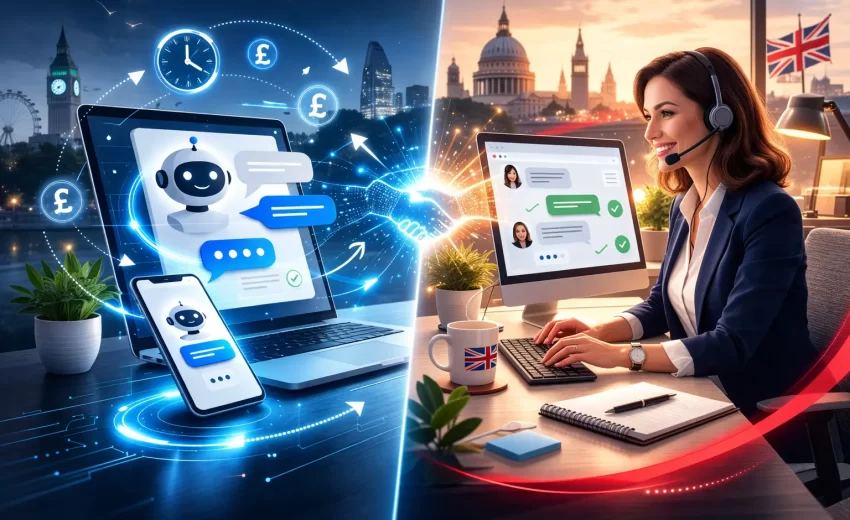
After everything I have shared in this guide, I want to be direct with you. The debate is not really AI chatbot versus live chat. The smartest UK businesses I have worked with are not choosing one or the other. They are building a hybrid chat support model that combines customer support automation with real human expertise saving money while keeping customers genuinely happy.
When set up correctly, this approach turns automated customer service into the front line of your UK business while keeping live agents available for every conversation that genuinely needs a human touch. It is the most effective form of omnichannel customer support available to UK businesses right now.
Here is exactly how to build it.
Step 1 : Automate Your Routine Customer Queries
The first thing I always do when helping a UK business build a hybrid setup is map out every customer query they receive in a typical week.
What you find almost every time is that the majority of queries are identical or very similar. Order tracking, pricing questions, return policies, opening hours and booking confirmations appear again and again. Customer query automation for UK businesses works best when you train your chatbot on these real recurring questions first rather than building around generic templates.
Pull your last three months of support conversations and identify your top fifteen most common questions. Build your chatbot responses around those. Once those are automated your live agents are free to focus entirely on conversations that genuinely need a human.
Step 2 : Set Up Chatbot Escalation to Human Agents
Chatbot escalation to human agents in UK businesses needs to feel completely invisible to the customer. They should never feel passed around or forced to repeat themselves.
Here is how I set this up properly.
Define your escalation triggers before going live. The most reliable triggers I use are repeated failed chatbot responses, complaint language, direct requests for a human agent, mentions of refunds or disputes and any signs of user distress. Programme your chatbot to recognise these signals and hand over immediately.
Always pass the full conversation transcript to the live agent. When your agent picks up they should already know exactly what the customer needs. That single step eliminates the most common frustration in hybrid chat experiences.
Step 3 : Create a Seamless Omnichannel Experience
UK customers move between your website, WhatsApp and social media channels fluidly. Your hybrid system needs to follow them.
A properly connected omnichannel customer support setup means your chatbot and live agents operate from one single platform. Conversation history follows the customer across every channel automatically. Most modern platforms including Intercom, Tidio and Freshdesk Messaging make this achievable even for smaller UK businesses.
Start with your two highest volume channels first. For most UK businesses that is website chat and WhatsApp. Get those connected and working well before expanding further.
How to Set Up a Hybrid Chatbot and Live Chat System UK
Follow these six steps to launch your hybrid system correctly from day one.
- Choose a platform supporting both AI chatbot and live chat natively
- Map your top fifteen recurring customer queries and build chatbot responses around them
- Define and test every escalation trigger before going live
- Connect your website chat and WhatsApp as your priority channels
- Brief your live agents on picking up escalated conversations smoothly using the transcript
- Monitor your chatbot resolution rate and escalation rate weekly for the first month and refine continuously
Live Chat vs AI Chatbot UK Small Business: How to Choose the Right Option in 3 Steps
I understand that after reading all of this, you might still feel unsure about which direction is right for your specific business. That is completely normal. When it comes to the human agent vs AI bot decision for UK small businesses, context matters more than features.
So let me make this as simple as possible. Here are three practical steps I walk small business owners through when they ask me this exact question.
Step 1 : Audit Your Current Customer Conversations
Before making any decision about AI chatbots or live chat I always tell UK business owners to start with their own data rather than assumptions.
Go through your last three months of customer support conversations. Count how many queries you received in total and then split them into two categories. Routine queries that follow a predictable pattern and complex queries that required genuine judgement or back and forth discussion.
If more than half of your conversations fall into the routine category you have a strong case for AI chatbot automation right now. If complex conversations dominate your inbox live chat needs to remain your priority channel.
Step 2 : Calculate Your True Support Costs
Most UK business owners I speak to dramatically underestimate what their current support setup actually costs them.
Do not just look at your live chat software subscription. Add up your agent salaries, employer National Insurance contributions, onboarding and training time, management overhead and the hidden cost of slow response times that cause customers to abandon their purchase or complaint entirely.
When you lay out those true support costs in pounds the financial case for AI chatbot automation becomes very difficult to argue against for routine query handling. A chatbot at £0.40 to £0.80 per interaction versus a human agent at £4 to £9 per interaction is a significant difference at any volume.
Step 3 : Start Small and Scale Based on Data
I never recommend overhauling your entire customer support setup overnight. The businesses that get the best results start focused and scale gradually.
Begin by automating your five most common routine queries with an AI chatbot. Measure the resolution rate after thirty days. If customers are getting what they need without escalation add five more query types and repeat the process.
Let the data guide every decision from that point forward.
Best Live Chat Software for UK Businesses in 2026: Top 5 Compared
Picking the wrong platform is a mistake I see UK businesses make all the time. They choose a tool based on a global review that has no understanding of UK data laws, UK pricing or UK customer behaviour.
So let me break down the best UK customer service software for 2026 into three clear categories — chatbot software for UK small businesses, live chat platforms and intelligent virtual assistant tools — so you can find the right fit quickly. I have included live chat software pricing for the UK market and flagged which platforms support omnichannel customer support including WhatsApp chatbot integration for UK businesses.
Best for UK Small Businesses : Tidio
Tidio is the platform I recommend most consistently to UK small businesses starting out with chat automation. Plans begin from around £25 per month and the setup takes less than a day. It offers solid UK GDPR compliance controls and integrates cleanly with Shopify and WordPress. The AI chatbot handles routine queries well and live chat is built in from the start.
Best for: Independent retailers and small UK service businesses on a tight budget.
Best AI Bot for Website UK : Intercom
If you want the most capable AI bot for your UK website Intercom leads the field. Its natural language processing is genuinely impressive and it handles complex multi-turn conversations better than most competitors. Pricing starts from around £74 per month. Data is stored within the EU meeting UK GDPR requirements comfortably.
Best for: Growing UK SaaS businesses and e-commerce brands wanting serious AI capability.
Best for Omnichannel Support : Freshdesk Messaging
Freshdesk Messaging connects your website chat, WhatsApp, Instagram and email into a single agent dashboard better than almost any platform at this price point. Plans start from around £15 per agent per month making it excellent value for UK businesses managing multiple customer channels simultaneously.
Best for: UK businesses where customers contact them across several different platforms daily.
Best for Hybrid Models : Intercom
Intercom wins this category too. The handover from AI chatbot to live agent is the smoothest I have experienced on any platform. Customers rarely notice the transition which is exactly what a well built hybrid model should achieve.
Best for: UK businesses serious about combining automation with genuine human support.
Best Budget Option : Tidio Free Plan
Tidio offers a genuinely functional free plan that covers basic AI chatbot automation and live chat for lower volume UK businesses. It is the most sensible starting point if you want to test the waters before committing to a paid subscription.
Best for: Early stage UK businesses wanting zero upfront cost.
Frequently Asked Questions: AI Chatbot vs Live Chat for UK Businesses
Is AI Chatbot or Live Chat Better for UK Small Businesses?
Start with a chatbot for high-volume simple queries and add live chat as your business grows and your customer needs become more complex. The overall chatbot customer experience in the UK has improved significantly in 2026, making it a viable starting point for most small businesses.
How Much Does a Chatbot Cost for a UK Business?
AI chatbot platforms in the UK typically start from around £25 to £80 per month for small business plans. Mid tier platforms with stronger AI capabilities and GDPR compliance tools cost between £150 and £500 per month. On a per conversation basis most UK businesses pay between £0.40 and £0.80 per chatbot interaction which is significantly cheaper than live chat which costs between £4 and £9 per interaction when you factor in agent salaries and overheads.
Do AI Chatbots Need to Comply with UK GDPR?
Yes absolutely. Any AI chatbot collecting personal data from UK customers must comply with UK GDPR and ICO regulations. This includes having a lawful basis for data collection, being transparent with customers about how their data is used and being able to action data access or deletion requests. Always check that your chatbot platform stores data in a UK or EEA compliant location before deploying it.
Can a Chatbot Replace a Live Chat Agent in the UK?
Not entirely and I would not recommend trying. AI chatbots handle routine queries brilliantly but they cannot replicate human empathy, judgement or the ability to navigate truly complex situations. The smartest UK businesses use AI chatbots to handle 60% to 70% of conversations and keep a live chat team for everything that requires a genuine human response.
What Is the UK Online Safety Act and How Does It Affect Chatbots?
The UK Online Safety Act requires businesses to ensure their AI tools cannot generate or facilitate harmful content particularly for vulnerable users. Since 2026 this legislation applies more broadly to AI powered chat tools. UK businesses must conduct risk assessments on their chatbots and ensure proper escalation protocols are in place. Ofcom oversees compliance and businesses are held responsible for the behaviour of any AI tool they deploy.
Which Is Better for UK E-Commerce — Chatbot or Live Chat?
For UK e-commerce customer support, AI chatbots are genuinely the stronger starting point The majority of customer queries in online retail involve order tracking, returns, delivery updates and product questions which chatbots handle instantly and accurately. I recommend keeping live chat available for complaints, high value purchase decisions and situations where a customer is clearly frustrated. That combination delivers both efficiency and customer satisfaction without breaking your support budget.
Should I Use a Chatbot or Live Chat for My UK Business?
It depends on your conversation volume, budget and the complexity of your customer queries. If most of your enquiries are routine and repetitive, an AI chatbot will save you money and respond faster. If your customers regularly need personalised advice or emotional support, live chat is essential. For most UK businesses in 2026, a hybrid approach that uses both is the strongest option.
Is an AI Chatbot Better Than Live Chat for Small Business UK?
For UK small businesses with limited staff and tight budgets, an AI chatbot often delivers better value as a starting point. It provides 24/7 coverage without staffing costs and handles high-volume routine queries efficiently. However, live chat should be added as soon as your business deals with complex customer issues, complaints or high-value transactions where a human touch makes the difference.
Is Live Chat Still Worth It for UK Businesses in 2026?
Absolutely. Despite the rapid growth of AI chatbots, live chat remains essential for any UK business that handles complex queries, sensitive customer data or high-value sales conversations. Customer satisfaction scores for live chat in the UK consistently outperform chatbot scores for these types of interactions. The most successful UK businesses use live chat strategically alongside AI chatbots rather than replacing it entirely.
Final Verdict: Which Is Right for Your UK Business in 2026?
We have covered a lot of ground in this guide and I want to leave you with a clear, honest answer rather than a vague “it depends” conclusion that leaves you no better off than when you started.
The verdict:
If your business handles mostly routine, repetitive customer queries order tracking, FAQs, appointment booking an AI chatbot should be your foundation. It is faster, cheaper and scales without limits.
If your business deals with complex, sensitive or high-value conversations financial advice, legal queries, healthcare, complaints live chat with trained human agents is non-negotiable.
If you want the best of both worlds and most UK businesses do the hybrid model is your answer. Start with a chatbot to handle volume. Add live chat for conversations that matter most. Use data to continuously improve both.
The UK business digital transformation happening right now means that standing still is not an option. The right UK customer service software in 2026 is not one tool or the other. It is both, working together intelligently.
Whatever you choose, choose deliberately. Your customers deserve it.

March 17, 2026
Custom AI Chatbot Development for Small Business UK

March 17, 2026